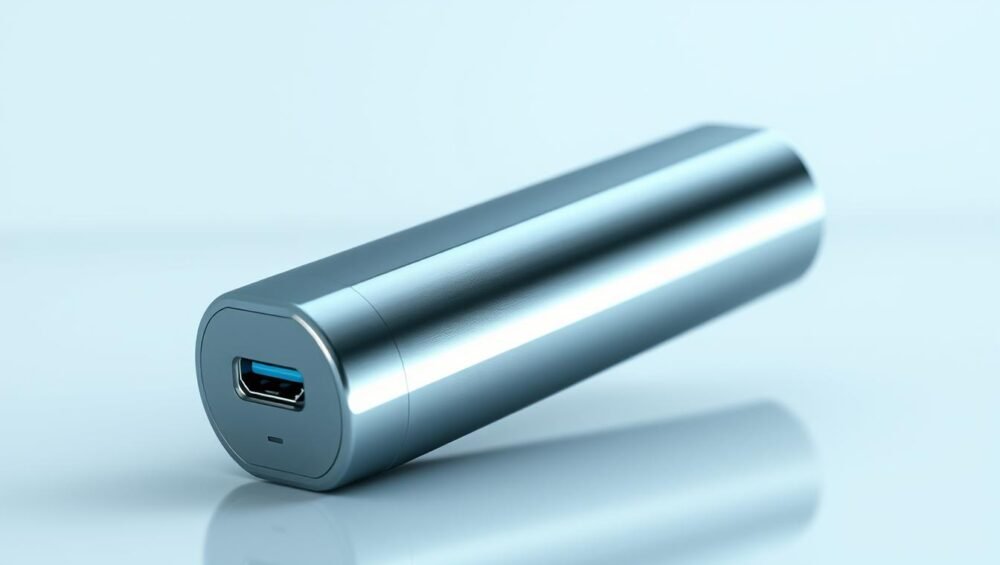
With the increasing performance of modern battery carriers (Mods) gain external lithium-ion cells like the formats 18650 and 21700 in importance. However, since these are high-energy industrial cells, which were not originally designed for the consumer market without a rigid housing, In-depth knowledge of safe handling is essential. According to YOUR ONE 62133 Improperly treated cells can cause thermal instabilities (Thermal Runaway) develop.
What do the names mean? 18650 and 21700?
The numbers classify the physical dimensions of the cylindrical cells:
- 18650: 18 mm diameter, 65 mm length. The proven industry standard for most e-cigarettes.
- 21700: 21 mm diameter, 70 mm length. This format offers larger volume for higher capacities (mAh) and higher Continuous discharge currents (CDR), something especially for sub-ohm vapers (DTL) is advantageous.
The critical importance of isolation (Wraps)
A lithium-ion battery has a negative polarity on almost the entire housing. Only the small pole at the head of the cell is positive. These poles are only through a thin Insulating ring and a plastic cover (Wrap) separated.
- Damaged protective covers: Scratches or tears in the wrap are a massive safety risk. If the exposed metal casing (negative pole) touches the metal wall of a mod, a short circuit occurs.
- Defective insulation rings: The small ring on the positive pole prevents direct contact between the poles. This one is missing, the cell must not be used.
- maintenance: Only use special battery heat shrink tubing Re-Wrap. Using tape is unsafe and increases the risk of fire.
Technical correction: Protected vs. Unprotected cells
A common misunderstanding concerns the term “protected”.
- Protected cells: Have an integrated protection circuit (PCB), which, however, limits the current output and lengthens the cell. They are usually unsuitable for high-performance e-cigarettes.
- Unprotected cells: The high performance cells common in the vaping industry (z. B. Molicel, Sony/Murata VTC-Serie, Samsung) are unprotected.
Important NOTE: Safety is guaranteed here by the electronics in the battery carrier. However, this requires impeccable physical integrity of the cell. For mechanical mods (without chip) The risk is highest for unprotected cells.
Aviation safety and IATA regulations (Stand 2026)
The transport of lithium-ion batteries is subject to strict regulations International Air Transport Association (IATA):
- No check-in luggage: Under no circumstances may spare batteries be transported in checked baggage.
- Hand luggage rule: Batteries must be inserted individually Insulated boxes (Battery Cases) be carried in hand luggage, to avoid short circuits caused by contact with keys or coins.
- Wh limit: Batteries up to 100 Wh are generally allowed. The calculation is done via: $(mAh times V) / 1000$. A typical 18650 battery is approx. 11 Wh.
Lademanagement: Intern vs. Extern
Although many devices offer USB-C ports, the Myvapesite expert editorial team recommends its use external chargers (z. B. from Nitecore or XTAR):
- precision: External devices often charge cells more gently and balance the voltages more precisely with dual battery mods.
- Thermal management: When charging internally in the mod, heat is generated directly on the electronics, which can shorten the lifespan of the device.
- Supervision: Never charge batteries unattended or overnight on flammable surfaces.
When does a battery have to be disposed of??
A battery should be charged after approx. 300-500 charging cycles can be properly recycled, if:
- It becomes unusually hot when charging or using it.
- The housing has dents or deformations.
- The capacity noticeably decreases or the charging time increases extremely.
Verifiable sources:
- YOUR ONE 62133: Safety requirements for portable gas-tight batteries.
- IATA Lithium Battery Guidance Document (2025/2026): Transport regulations for dangerous goods.
- Battery University (Isidore Buchmann): Studies on cycling stability and storage of Li-ion cells.
Disclaimer: This article is intended for technical information. You handle high-energy cells at your own risk. Please note the battery manufacturer’s warnings.