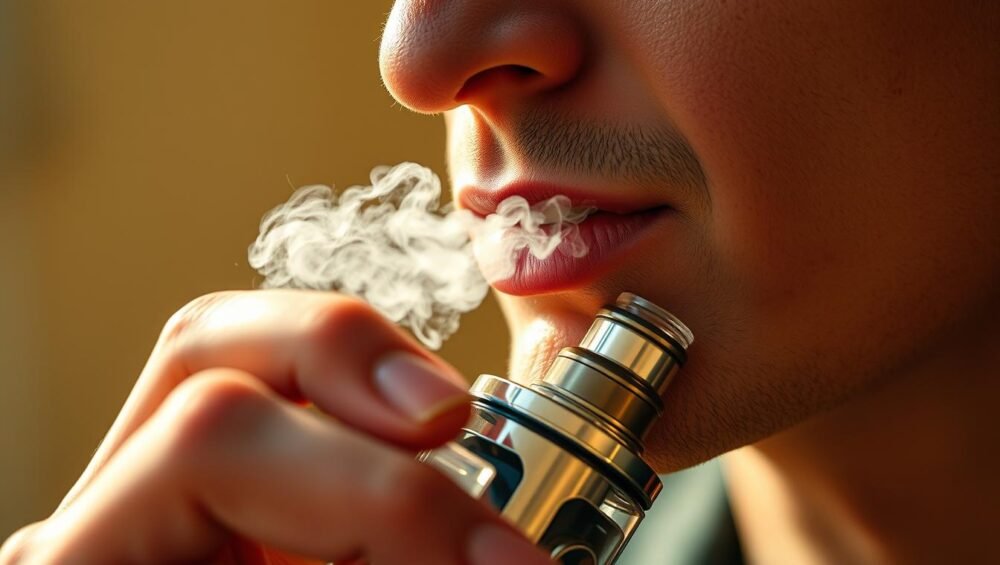
The e-cigarette has established itself as a significantly less harmful alternative to tobacco cigarettes for many adult smokers. Nevertheless, there are clear limits: For Adolescents and pregnant women The consumption of e-cigarettes is absolutely not recommended.
As a responsible specialist retailer, it is important to us, to educate people about the risks and to make an active contribution to the protection of minors.
Child protection and pregnancy: Why responsibility comes first when vaping

E-cigarettes are not “Water vapor”
A common misconception is, that e-cigarettes only produce harmless water vapor. In reality it is a Aerosol. This consists of fine particles of propylene glycol, Glycerin, Flavorings and – in most cases – nicotine. While this aerosol contains far fewer toxins than tobacco smoke (over 4.000 releases chemicals), It is still risky for the development of adolescents and unborn children.
Risks to adolescents and brain development
Puberty is a period of rapid physical and neurological growth. Studies show, that the brain up to about 25. Year of life matures.
- Nicotine addiction: The adolescent brain is much more sensitive to nicotine than that of an adult. The risk of lifelong addiction is significantly higher if you start early.
- Cognitive impairments: Nicotine can affect the development of areas of the brain, those for attention, are responsible for learning and impulse control.
- Prevention: E-cigarettes are a tool for adult smoking cessation and should never be used as a lifestyle product for minors.
E-cigarettes during pregnancy: Protection for the unborn child
During pregnancy, mother and child share the same bloodstream. Any substance, which the mother inhales, can reach the fetus via the placenta.
- Danger to development: Nicotine has a vasoconstrictor effect. This can be the oxygen- and nutrient supply to the child. It is associated with lower birth weight and potential lung problems in the newborn.
- Expert opinion: Auch Gregory Conley, President of the American Vaping Association, emphasized, that pregnant women should avoid any form of nicotine - this also includes medical nicotine replacement products such as patches or chewing gum, unless expressly prescribed by a doctor.
Are nicotine-free liquids an alternative?
The question often arises, whether nicotine-free e-liquids are safe for these groups. Although they do not contain nicotine, The study situation on the effects of flavoring substances on fetal development is not yet sufficiently clear.
In addition, the protection of minors is a top priority: In Germany, nicotine-free products are also subject to the ban on sales to minors in accordance with the Juvenile Protection Act (JuSchG). For young people, the goal should always be a completely addiction-free life.
Our conclusion on responsibility
E-cigarettes are a valuable tool for... Smoking cessation in adult long-term smokers. For all other groups, especially pregnant women and young people, gilt: The safest health choice is to avoid inhalation products completely.
We consistently support the protection of minors through strict age checks and transparent information.